
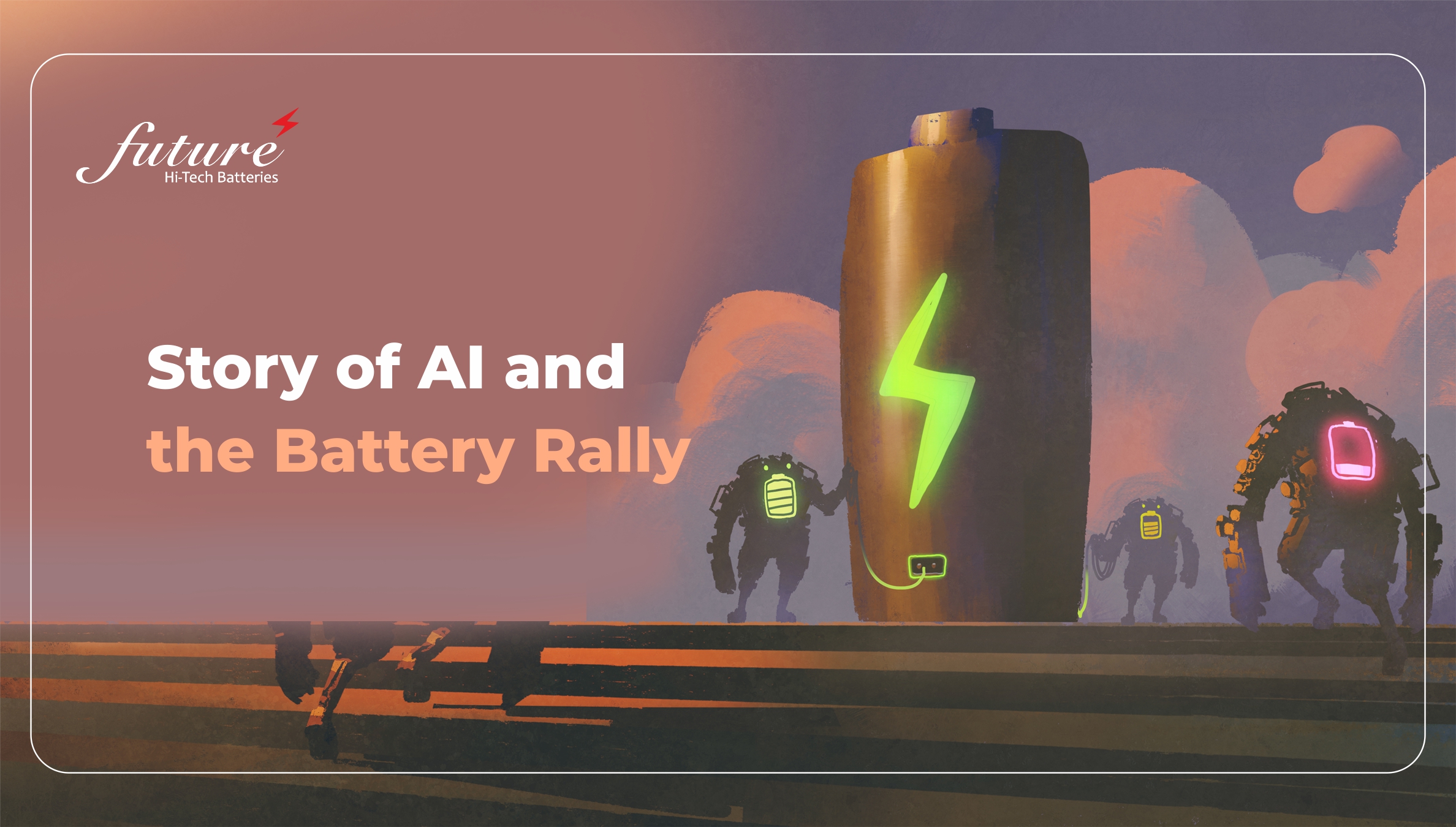
It’s comical how we talk about the future as if it’s this clean, weightless thing. We’ve been conditioned to imagine a world made of holograms and invisible “clouds,” but the reality is a lot heavier—and a lot more metallic. If you pull back the curtain on the so-called AI Revolution, you don’t find an ethereal digital heaven; you find a massive, humming warehouse of lithium ion battery packs. The truth is that our most advanced “brains” are tethered to a very physical, very demanding stomach. We’re finally realizing that the “Silicon Mind” is only as good as the hardware that feeds it, and that realization has changed everything.
We are currently living through a phenomenon I call the Battery Rally. It’s a moment in history where our digital ambitions have officially outpaced our physical infrastructure, sparking a global scramble for “White Gold” that feels less like a polished tech launch and more like a desperate, 19th-century gold rush. It’s a wild, high-stakes race where the prize isn’t just a better smartphone or a faster car, but the very foundation of global power. To see where we’re headed, you have to understand how the world’s smartest software became completely obsessed with the world’s most stubborn hardware.
The Great Hunger
For a long time, AI was just a toy for researchers. But when generative AI went mainstream, it changed the math of the global power grid. These models don’t just “think”; they consume. A single AI-generated image or a complex query uses significantly more electricity than a standard Google search.
As Silicon Valley races to build “God-like” intelligence, they’ve run into a very grounded problem: the grid is tired. It’s old, it’s leaky, and it’s still largely dependent on fuels that are subject to the whims of global politics. Tech giants realized that if they wanted to keep their data centers running 24/7 without being held hostage by fluctuating oil prices or carbon taxes, they needed to own the energy.
This was the spark for the Battery Rally. In this scenario, lithium-ion banks weren’t just now for laptops or EVs; they became the literal heartbeat of the digital economy. If you want a “Silicon Mind,” you need a lithium stomach to feed it.
The “Lithium Ion Battery Iron Curtain”
As the rally picked up speed, it hit the brick wall of geopolitics. For the last twenty years, we lived in a world that prioritized efficiency above all else. We built supply chains that stretched across the globe because it was cheap. But the “Great Decoupling” has changed everything.
We are now seeing the rise of what some call the Battery Iron Curtain. Nations have realized that energy storage is no longer just a “green” initiative—it’s a matter of national security. If your AI infrastructure, your transport, and your military all run on batteries, you cannot afford to have your supply chain controlled by a geopolitical rival.
This has led to a frantic, almost desperate push for domestic manufacturing. From the vast “Gigafactories” rising in the American Southwest to the strategic corridors of Europe, the goal is energy sovereignty. The rally isn’t just about who can build the best battery; it’s about who can build them at home.
India’s Front-Row Seat
Nowhere is this drama more intense than in India. If you want to see the Battery Rally in its rawest, most transformative form, look at the streets of Delhi or the rural farms of Punjab. India has set some of the most ambitious energy goals on the planet—the Panchamrit targets—aiming for a massive 500 GW of non-fossil capacity by 2030.
But there’s a catch: the sun doesn’t shine at night, and the wind doesn’t always blow. To overcome the lag, India has strategically designed pivot towards the decentralized storage system. Through initiatives like the PM-KUSUM scheme, they are converting farms into mini-power plants.
But the real human story here is the shift from being a consumer to a creator. India is tired of being the place that just assembles the world’s tech. The country is moving towards mastering the entire lifecycle of the battery. It’s a bid to ensure that as the world moves away from oil, India isn’t just trading one dependency for another.
When AI Meets the HESS
The technology itself is evolving under the pressure of the rally. We’ve reached the limits of what a simple battery pack can do, thus leading us to Hybrid Energy Storage Systems (HESS).
Think of a standard lithium ion battery pack like a long-distance hiker: steady, reliable, but slow to react. A HESS adds a “sprinter” into the mix—usually a supercapacitor or a high-power cell. But managing two different types of storage at the same time is a nightmare for a human operator.
This is where the story comes full circle. We are now using AI to manage the batteries that power the AI. These algorithms act as the “brain” of the HESS, making micro-decisions every millisecond. “Should I pull power from the capacitor to stop this grid flicker? Or should I draw from the lithium bank to handle this sustained load?”
It’s a level of precision that makes our old electrical grids look like steam engines. We are building a symbiotic organism where the software and the hardware are constantly talking to each other just to keep the lights on.
The Ethics of the “White Gold”
We have to be honest about the cost of this rally. Calling lithium “White Gold” makes it sound clean and magical, but mining it is a gritty, water-intensive process that often happens in some of the most fragile ecosystems on Earth.
The human element of the Battery Rally involves a difficult conversation about sacrifice. How much water are we willing to use in the Andes to power a data center in Virginia? This is where the rally is forcing us to grow up. We are seeing a massive push for a “Circular Battery Economy.”
Again, AI is the hero here. We’re seeing new models that can track a single battery’s health from the moment it leaves the factory to the moment it’s recycled, ensuring that not a single gram of lithium is wasted. The rally is shifting from a race of extraction to a race of stewardship.
The Feedback Loop for Lithium ion batteries
If you step back and look at the big picture, the story of AI and the Battery Rally is a perfect feedback loop.
- 1. AI is used to discover new materials and also manages complex grid systems.
- 2. Batteries are used to provide stable and high degree of power needed by the system.
- 3. Performance of AI is directly proportional to the outcome of the batteries.
The Bottom Line
In the end, the Battery Rally is about more than just stock prices or technical specifications. It’s about a fundamental shift in how humans relate to the Earth. For over a century, we fueled our progress by burning things. We took carbon from the ground, set it on fire, and let the waste float into the sky.
The AI and Battery era is different; it’s about capturing and holding. It’s about the elegance of the electron. It’s about a world where our “intelligence” isn’t just a program on a screen, but a physical partner that helps us manage the very energy that sustains us.
The next decade won’t be won by the company with the flashiest app. It will be won by the people who can master the heavy, metallic, and deeply human art of the battery. The rally is on, and for the first time, we have the tools to actually finish the race.
Follow us on LinkedIn.



Your Comment Please