
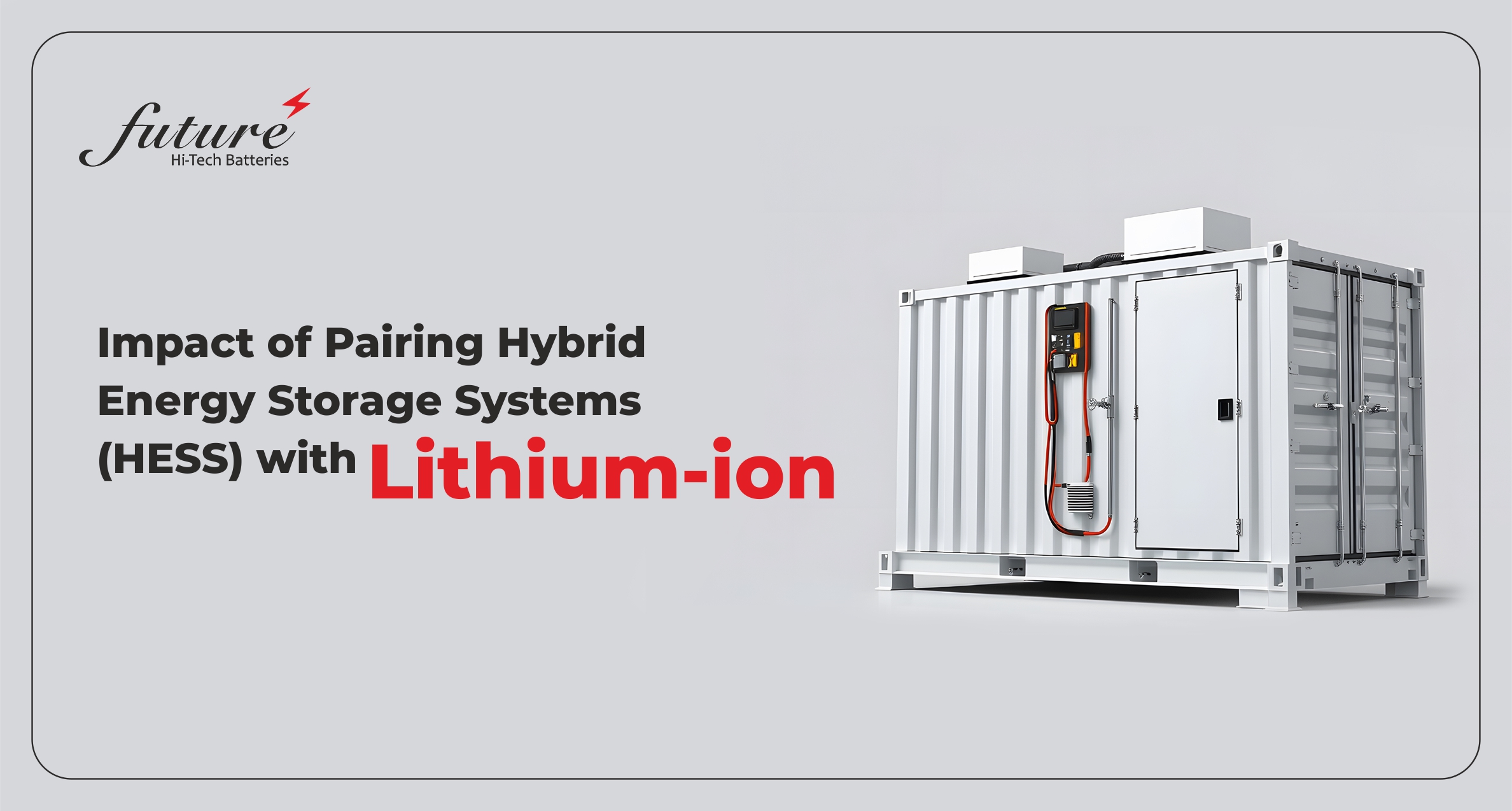
To understand the reason for the emphasis on the pairing of Hybrid Energy Storage Systems (HESS) and Lithium-ion as a big deal, one has to stop thinking about batteries as “magic boxes” and start thinking of them as living, breathing things that get tired.
We live in a world that is obsessed with Lithium-ion. It’s the rockstar of the energy world. But even the best rockstar needs a crew, a manager, and a backup support to actually make things happen. In the energy grid of the future, HESS is that support system. It’s the difference between a battery that burns out in five years and one that powers a neighborhood for twenty.
The Problem: We Are Bullying Our Batteries
Let’s be honest: we are incredibly mean to our Lithium-ion batteries.
The chemistry inside a Lithium-ion cell is delicate. It relies on ions traveling back and forth through a liquid electrolyte, wedging themselves into a lattice of graphite or metal oxides. When you use a battery “normally”—like watching a video on your phone—it’s a routine basic utilization. But when you ask it to do something violent, like floor the accelerator in a Tesla or stabilize a power grid when a massive wind gust hits, you are effectively forcing those ions to move at a speed they weren’t designed for.
This causes “interfacial stress.” It creates heat. It causes the internal materials to expand and contract so much that they literally start to crumble at a microscopic level. If you’ve ever noticed your laptop getting hot when you run a heavy program, you’re feeling the battery’s “protest.” On a grid level, these protests lead to shortened lifespans and, in the worst-case scenarios, fires.
Role of HESS: The partnership duo that works
A Hybrid Energy Storage System (HESS) is basically a marriage of opposites. You take your Lithium-ion battery (the high-energy, slow-and-steady partner) and you pair it with something like a Supercapacitor or a Flywheel (the high-power, lightning-fast partner).
If Lithium-ion is a marathon runner, a Supercapacitor is a world-class sprinter. The runner can go for 26 miles, but they can’t dodge a bullet. The sprinter can move instantly, but they’re exhausted after 10 seconds. When you put them together, you get a “super-athlete” that can work as a wonder.
How the Partnership Actually Changes the Game
- The “Buffer” Effect
In a standard setup, every tiny “jitter” in the power grid hits the battery. In a HESS setup, there is a digital gatekeeper (a power converter) that watches the incoming demand. If it sees a sudden, sharp spike—the kind that happens when a factory turns on a massive arc welder—it tells the Supercapacitor to handle it. The Lithium-ion battery never even “feels” the spike. It just keeps humming along, providing a steady baseline. This “peak shaving” is the single most important impact of the pairing. It turns a chaotic, jagged electrical signal into a smooth, manageable one.
- Doubling the Lifespan
We often talk about “cycle life”—how many times you can charge and discharge a battery before it dies. But not all cycles are created equal. One “hard” cycle at high temperature is worse than ten “gentle” cycles. By offloading the high-stress tasks to the HESS partner, the Lithium-ion battery stays in its “comfort zone.” It runs cooler. Its chemical structure stays intact. For a utility company, this is the Holy Grail. If you don’t have to spend $50 million to replace your battery bank every seven years because it’s now going to last fifteen, the economics of renewable energy suddenly make a lot more sense.
- Solving the “Renewable Jitters”
The biggest argument against wind and solar has always been “intermittency.” The sun goes behind a cloud, or the wind stops blowing, and the power drops instantly. Standard batteries are fast, but they aren’t “instant.” There is a tiny lag—a few milliseconds—where the chemistry has to catch up. In the world of high-speed electronics, a few milliseconds is an eternity. A HESS system can react in microseconds. It fills that gap perfectly, providing what engineers call “synthetic inertia.” It makes the grid feel as solid and reliable as the old coal-fired days, but without the smokestacks.
Why This Isn’t Just Theory: The Electric Vehicle Angle
The impact of this pairing is perhaps most visible in the things we drive. Imagine you’re driving an electric bus. Every time the bus stops, it uses “regenerative braking” to turn motion back into electricity.
That’s a huge, violent burst of energy hitting the system all at once. A Lithium battery is like a narrow funnel; it can’t take it all. Most of that energy is wasted. But if that bus has a HESS (a small pack of supercapacitors), it catches that energy like a baseball mitt. Then, as the bus starts moving again, it feeds that energy back to the motor. The result? The bus goes further on a single charge, and the battery doesn’t get “fried” by the constant stopping and starting.
The Hidden Cost of “Being Too Simple”
So, why isn’t this everywhere yet? Why isn’t every battery a hybrid?
It’s the “VCR” problem. It’s much easier to sell a simple machine than a complex one. A HESS requires sophisticated software and extra hardware (DC-DC converters) to manage the flow of electricity between the two different storage types. It’s more expensive to build on day one. As we get more serious about climate change, we’re realizing that “cheap and simple” usually ends up being “expensive and complicated” in the long run. The industry is shifting towards “Total Cost of Ownership,” and in that calculative perspective, the HESS-Lithium pairing wins every single time.
The Human Perspective: Why We Should Care
At the end of the day, this isn’t just about volts, amps, and chemical lattices. It’s about making a green future actually work.
We want a world where we don’t have to worry about the grid crashing because it’s a cloudy day. We want electric cars that are affordable because the batteries last for twenty years instead of eight. We want to stop mining the earth for Lithium quite so aggressively, which we can only do if we make the Lithium we already, have last twice as long.
The impact of pairing HESS with Lithium-ion is, ultimately, a way of smarter resource management and a boon for our lives.
A Final Thought
If you look at the history of technology, the biggest breakthroughs usually happen when two different things interacting with each other. The smartphone evolved when the phone met the computer. The HESS-Lithium pairing is that kind of union. It’s the moment energy storage stops being a “dumb tank” and starts being an intelligent, responsive system.
It’s the muscle and the hustle, working together. And that’s a partnership that’s going to change how we power the world.
Follow us on LinkedIn.



Your Comment Please