
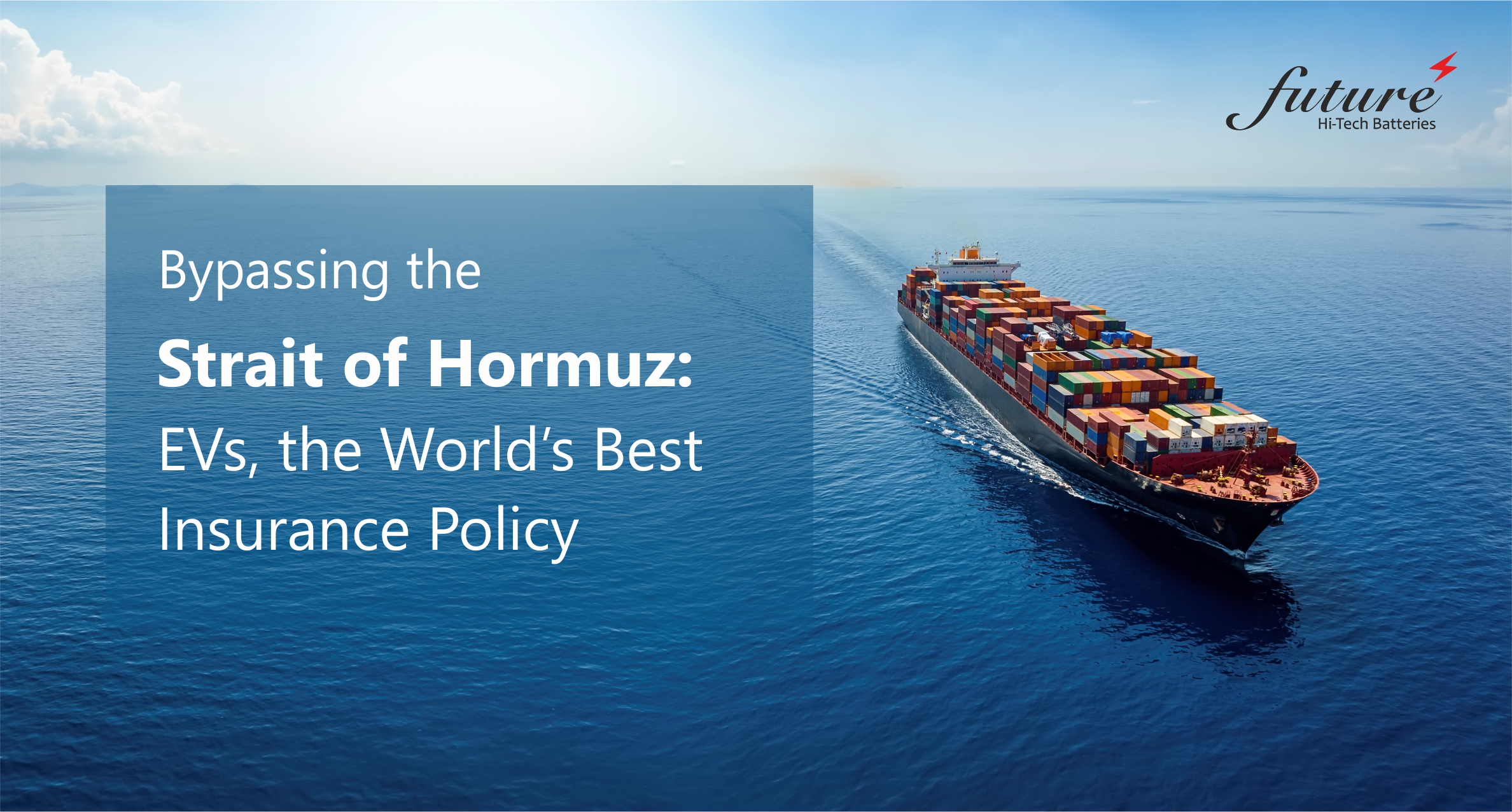
For over half a century, the global economy has been held hostage by a geographic fluke. If you look at a map of the Middle East, there is a tiny, hooked finger of water separating the rocky coast of Oman from the jagged cliffs of Iran. This is the Strait of Hormuz. At it is the narrowest, the shipping lanes are only two miles wide. Yet, through this tiny needle’s eye flows the lifeblood of modern civilization: nearly 21 million barrels of oil every single day.
As we navigate the complexities of 2026, the Strait remains the world’s most sensitive “chokepoint.” A single diplomatic spat, a stray sea mine, or a localized skirmish can—and does—send shockwaves to gas stations in Ohio, factories in Germany, and farms in Vietnam. We have spent trillions of dollars on naval carrier groups and strategic reserves to manage this anxiety.
But a more permanent solution has emerged, and it isn’t a new pipeline or a peace treaty. It is the vehicle parked in your neighbour’s driveway. The Electric Vehicle (EV) is no longer just an environmental statement; it is a decentralized, high-tech bypass of the world’s most dangerous waterway.
The “Hormuz Tax”: A History of Volatility
To understand why Electric Vehicles are an “insurance policy,” we have to look at what they are insuring us against. For decades, the “Hormuz Tax” has been an invisible line item on every bill you pay. As the world’s transport is roughly 90% dependent on petroleum, any hiccup in the Strait causes oil prices to spike.
This isn’t just about the cost of a gallon of gas. It’s about the cost of the plastic in your phone, the fertilizer for your food, and the jet fuel for your flights. When the Strait is threatened, inflation doesn’t just rise—it explodes. In the past, the only way to mitigate this was through massive military spending to “keep the lanes open.” We’ve been paying for energy security with blood and treasure for fifty years.
The Electric Vehicles as a Strategic Escape Hatch
The key advantage of the EV transition is that it changes the fundamental math of energy dependence. When you drive an Internal Combustion Engine (ICE) vehicle, you are a consumer of a global commodity. That oil is pulled from a well in one country, refined in another, and shipped through critical routes like Hormuz to reach you. You are dependant on a complex supply chain.
When you drive Electric Vehicles, you are a consumer of local electrons.
- Decentralized Power: Whether your local grid is fed by a nuclear plant, a wind farm, or the solar panels on your own roof, those electrons don’t have to pass through a naval blockade.
- Price Insulation: Electricity prices are generally regulated and far more stable than the Brent Crude index. By shifting from oil to the grid, nations effectively “insulate” their citizens from the geopolitical whims of the Persian Gulf.
- The End of Selective Pressure: Historically, nations have used oil as a “weapon” (as seen in the 1970s). You cannot “embargo” sunlight or wind. By electrifying transport, a nation regains its strategic autonomy.
Breaking the Monopoly of Geography
The traditional “fix” for the Strait of Hormuz was always more infrastructure. Saudi Arabia built the East-West Pipeline; the UAE built the Habshan–Fujairah line. These were attempts to literally pump oil around the bottleneck. But pipelines are fixed targets. They are expensive, take a decade to permit, and can be disabled with a single drone strike.
The EV “bypass” is different because it is organic and distributed. Every time a consumer chooses an EV over a gas car, they are effectively removing a tiny fraction of the world’s demand for Hormuz-bound oil. In 2025 alone, EV adoption avoided the need for nearly 1.8 million barrels of oil per day. By 2030, that number could triple.
We are essentially building a virtual pipeline that doesn’t exist in one place, but in millions of battery packs across the globe.
The “Great Hedging”: Even Oil Giants are Buying Insurance
The signs indicating towards the need of the EV insurance policy is the behavior of the oil producers themselves. If EVs were just a passing fad, nations like Saudi Arabia wouldn’t be pouring billions into their own EV brands or solar mega-projects.
They recognize the “Hormuz Dilemma” better than anyone. They know that as long as the world is addicted to oil, their own backyard remains a target for conflict. By diversifying into electricity, they are insuring themselves against the inevitable day when the oil stops flowing—whether because the wells run dry or because the world simply stops buying it.
The Economic Comparison: Stability vs. Chaos
| Feature | The Oil-Standard Economy | The EV-Standard Economy |
| Supply Chain | Fragile, global, maritime | Robust, regional, electrical |
| Primary Risk | War, piracy, blockades | Grid stability, mineral sourcing |
| Price Driver | Geopolitical tension | Infrastructure investment |
| Security Cost | High (Naval fleets/defense) | Moderate (Grid hardening) |
The “Fine Print” of the Insurance Policy
No insurance policy is without a deductible. As we bypass the Strait of Hormuz, we have to be careful not to create a “Strait of Lithium.” The minerals required for batteries—lithium, cobalt, nickel—have their own geographic concentrations.
However, there is a fundamental difference: Oil is consumed; minerals are borrowed. Once you burn a gallon of gas, it’s gone, and you need a new one from the Strait. Once you put lithium into a battery, it stays there for 10 to 15 years, and then it can be recycled. This “circularity” is what make the Electric Vehicles a superior security tool. We aren’t just swapping one fuel for another; we are swapping a “disposable” energy system for a “permanent” one.
The Human Element: Peace Through Technology
We often talk about Electric Vehicles in terms of gigatons of CO2 or kilowatt-hours. But the human story is about freedom. It’s about the freedom of a small nation to decide its own foreign policy without worrying that its transport system will collapse if a foreign power gets angry. It’s about the freedom of a family to know that their cost of getting to work won’t double next week because of a skirmish 8,000 miles away.
In 2026, the Strait of Hormuz remains a dangerous place. But its power to cripple the world is fading. The EV transition is the most ambitious peace project of the 21st century. It is a quiet, steady, and inevitable decoupling of human mobility from the world’s most volatile geography.
We are finally building a world where the “needle’s eye” of Hormuz no longer matters—because we’ve finally found a way to stop threading it.
Follow us on LinkedIn.

Your Comment Please